Click Here For Free Blog Templates!!!
Blogaholic Designs

Pages

Thursday, 14 November 2013

Sharing Session

Sharing Session

In this week, dr. ummi have invited one of the talented entrepreneur namely Mdm.Asnidar  Hanim Yusuf owner of Oshima Japan Restaurant. We have been told that Oshima mean a huge island. Actually Mdm. Asnidar Hanim is one of dr. ummi’s friends and before this mdm. Hanim take degree in engineering at Japan and continue his master also in that field now she further her pHd in USIM..


Oshima Japan Restaurant have stated it business in 2009 and operated at kiosk B3, Shah Alam Walk, Persiaran Majlis 40000 Shah Alam , Selangor. It is the one and only 100% HALAL Japanese Restaurant in Malaysia. The services have in there is takes reservations, walk-ins welcome, good for groups, good for kids, take out, delivery, catering, waiter service and outdoor seating.


The input i get in the sharing session conducted by Mdm. Asnidar Hanim is we must like or has a passion in everything we do. by that way, every obstacle that we will face it will not push our motivated down. Other than that, in business the competitive advantages is important to make our business more successful and it must different from others....

anyway, i enjoyed this session..:)
Sunday, 10 November 2013

chapter 6: Strengthening A Company’s Competitive Position

In chapter 6  namely: STRENGTHENING A COMPANY’S COMPETITIVE POSITION: STRATEGIC MOVES, TIMING, AND SCOPE OF OPERATIONS

If someone wants to open a company, that company must have a powerful strategy to compete with the existing company. The can use:
  •         Offensive and Defensive Competitive Actions
  •   Competitive Dynamics and the Timing of Strategic Moves
  •   Scope of Operations along the Industry’s Value Chain

OFFENSIVE AND DEFENSIVE COMPETITIVE ACTIONS

Defensive Marketing Strategies

Because of ongoing rivalry, established firms need to engage in defensive strategies to fend off the various challengers. The primary purpose of defensive strategy is to make a possible attack unattractive and discourage potential challengers from attacking another firm.

Incumbents try to shape the challenger’s expectations about the industry’s profitability and convince them that the return on their investment will be so low that it does not warrant making an investment in that industry. Defensive strategies work better when they take place before the challenger makes an investment in the industry, or if they enter the industry before exit barriers are raised, making it difficult for the challenger to leave the industry.

For this reason, an incumbent needs to take timely action to discourage a challenger from making any substantial commitment, because once the commitment is made, it is more difficult to dissuade the challenger from following through with the attack especially if exit barriers are high. If an attack has already begun, a defending firm may attempt to lower its intensity and potential for harm, by directing the attack to areas where the firm is less vulnerable, or in areas which are less desirable to the attacker.

Offensive Marketing Strategies

Firms engage in offensive marketing strategies to improve their own competitive position by taking market share away from rivals. Offensive strategies include direct and indirect attacks or moving into new markets to avoid incumbent competitors. If a firm possesses superior resources a direct attack may be called for. However, if a firm faces superior rivals, indirect attacks are more appropriate than direct, frontal attacks. Direct attacks invite retaliatory responses especially if they pose a serious threat to the defending firm.

 Indirect attacks are less likely to elicit a competitive response because that are difficult to detect, especially if they are targeted towards non-core segments or products. An extreme form of an indirect attack is to avoid competitors and undertake activities that are far removed from those of rivals.

Firms may choose from a multitude of different strategies to accomplish their offensive objectives. Like defensive strategies, offensive marketing strategies take many forms from flanking attacks or bypassing the competition to all-out frontal attacks intended to defeat the competition with all available means at the attacker’s disposal.

Blue-Ocean Strategy

Where the industry has not yet taken shape, with no rivals and wide-open long- term growth and profit potential for a firm that can create demand for new types of products.

The example of blue ocean strategy :

The Body Shop also created a “Blue Ocean” – and in the fiercely competitive cosmetics industry. The Body Shop ignored most glamorous aspects of the industry. Instead The Body Shop designed its image around functionality, reduced prices and modest packaging. Increased value was given to natural ingredients, a healthy lifestyle and ethical concerns.

          As a result The Body Shop’s products spoke to a totally new group of customers and achieved a high degree of cost savings (generally approx. 85% of costs in the cosmetics industry arise from packaging and advertising).

STRATEGIC MOVES

  §  When pioneering helps build a firm’s reputation and creates strong brand loyalty.
  §  When a first mover’s customers will thereafter face significant switching costs.
  §  When property rights protections thwart rapid imitation of the initial move.
  §  When an early lead enables movement down the learning curve ahead of rivals. 
  §  When a first mover can set the technical standard for the industry.

DEFINING THE SCOPE OF THE FIRM’S OPERATIONS

  ü  Range of its activities performed internally
  ü  Breadth of its product and service offerings
  ü  Extent of its geographic market presence and its mix of businesses
  ü  Size of its competitive footprint on its market or industry

Horizontal Scope
  • The range of product and service segments that a firm serves within its focal market.
Vertical Scope
  • The extent to which a firm’s internal activities encompass one, some, many, or all of the activities that make up an industry’s entire value chain system, ranging from raw-material production to final sales and service activities.
Backward Integration
  • Involves entry into activities previously performed by suppliers or other enterprises positioned along earlier stages of the industry value chain system.
Forward Integration
  • Involves entry into value chain system activities closer to the end user.
Strategic Alliance
  • A formal agreement between two or more separate companies in which they agree to work cooperatively toward some common objective.Joint Venture
Joint Venture
  • A partnership involving the establishment of an independent corporate entity that the partners own and control jointly, sharing in its revenues and expenses.

this is what i have learnt in this chapter...insyaallah i will improve it more.....JJJ


Saturday, 9 November 2013
according to what miss ummi told i to do:

4 Categories Of Generic Business Strategies

Broad Cost Leadership 
·         Google
·         Facebook
·         Air Asia
·         Coca Cola
·         Mydin
·         Giant
·         Digi
·         Maxis
·         McDonald’s


Focused Cost 
·         Tesco
·         Proton
·         Subway
·         KFC
·         Perodua
·         Kamdar
·         Toyota
·         Victorious Secret


Broad Differentiation 
·         Avon
·         Kia Motors
·         IKEA
·         Old-Town Kopitiam
·         Al-Ikhsan
·         Honda


Focused Differentiation
·        Bonia
·        JW Marriott
·        Louis Vuitton
·        Porsche
·        Malaysia Airlines Systems
·        Rolls Royce
·        Nike


Thursday, 24 October 2013

chapter 5: The Five Generic Competitive Strategies: Which One to Employ?

This week, we moved to chapter five, namely…THE FIVE GENERIC COMPETITIVE STRATEGIES: WHICH ONE TO EMPLOY?

In this chapter, I have learned how to make a business more strategies by using the 5 generic competitive strategies.


LOW COST PROVIDER

Low cost provider strategy is a basis for competitive advantage is lower overall costs than competitors. It pursue cost-savings that are difficult imitate and avoid reducing product quality to unacceptable levels. A cost driver is a factor that has a strong influence on a firm’s costs. It is a factor with a strong influence on a firm’s costs and can be asset or activity-based. 
For instant, Air Asia is one of the examples of low cost provider strategy. How does Air Asia could manage to offer cheaper airfares? The answer is Air Asia are using cost-cutting method in order to minimize it expenditure. Cost-cutting method allows Air Asia to:  
  • Striving to capture all available economies of scale.
  • Taking full advantage of experience and learning-curve effects.
  •  Trying to operate facilities at full capacity.
  • Improving supply chain efficiency.
  • Using lower cost inputs wherever doing so will not entail too great a sacrifice in quality.
  • Using the firm’s bargaining power vis-à-vis suppliers or others in the value chain system to gain concessions.
  • Using communication systems and information technology to achieve operating efficiencies.


It gives advantage over rivals can translate into better profitability than rivals attain.
this is the example of cost leadership strategy:


BROAD DIFFERENTIATION

Broad differentiation strategy is to offer unique product attributes that a wide range of buyers find appealing and worth paying for. A uniqueness driver is a factor that can have a strong differentiating effect. Effective differentiation approaches happen when consumer willingness to pay for a unique product or service, buyers can create a sustainably distinctive product offering and lastly the firm use higher prices to recoup differentiation costs. Uniqueness driver can:
  • Have a strong differentiating effect.
  • Be based on physical as well as functional attributes of a firm’s products.
  • Be the result of superior performance capabilities of the firm’s human capital.
  •  Have an effect on more than one of the firm’s value chain activities.
  •  Create a perception of value (brand loyalty) in buyers where there is little reason for it to exist.

example of differentiation strategy:


Through differentiation also it can approached to enhancing differentiation through changes in the value chain system by coordinating with channel allies to enhance customer perceptions of value and coordinating with suppliers to better address customer needs but there is a differentiation that is difficult for rivals to duplicate or imitate:
  • Company reputation
  • Long-standing relationships with buyers
  •  Unique product or service image


FOCUSED (OR MARKET NICHE) STRATEGIES

example of focused strategy

It can be divided in two ways:

Focused cost leadership is the first of two focus strategies. A focused cost leadership strategy requires competing based on price to target a narrow market. A firm that follows this strategy does not necessarily charge the lowest prices in the industry.
 Instead, it charges low prices relative to other firms that compete within the target market. Redbox(us), for example, uses vending machines placed outside grocery stores and other retail outlets to rent DVDs of movies for $1. There are ways to view movies even cheaper, such as through the flat-fee streaming video subscriptions offered by Netflix. But among firms that rent actual DVDs, Redbox offers unparalleled levels of low price and high convenience.


Focused differentiation is the second of two focus strategies. A focused differentiation strategy requires offering unique features that fulfill the demands of a narrow market. As with a focused low-cost strategy, narrow markets are defined in different ways in different settings. Some firms using a focused differentiation strategy concentrate their efforts on a particular sales channel, such as selling over the Internet only. Others target particular demographic groups.
While a differentiation strategy involves offering unique features that appeal to a variety of customers, the need to satisfy the desires of a narrow market means that the pursuit of uniqueness is often taken to the proverbial “next level” by firms using a focused differentiation strategy. Thus the unique features provided by firms following a focused differentiation strategy are often specialized.

The dedication of Mercedes-Benz to cutting-edge technology, styling, and safety innovations has made the firm’s vehicles prized by those who are rich enough to afford them. This appeal has existing for many decades. In 1970, acid-rocker Janis Joplin recorded a song called “Mercedes Benz” that highlighted the automaker’s allure. Since then Mercedes-Benz has used the song in several television commercials, including during the 2011 Super Bowl.

BEST COST PROVIDER STRATEGY

Are a hybrid of low-cost provider and differentiation strategies that aim at providing desired quality/features/ performance/service attributes while beating rivals on price.


Sunday, 6 October 2013

chapter 4: Evaluating Company’s Resources, Capability & Competitiveness

Let start chapter four….EVALUATING COMPANY’S RESOURCES, CAPABILITY & COMPETITIVENESS

In this chapter I have learned how to make a company more excellent and competitive. As example, dr. Ummi have discussed about Mc Donald. What make Mc Donald different from others company? Is it the tastes, the standard of the quality of burger or others? That is what makes Mc Donald different from others and it also Mc Donald's strength.

A company can move on if it can manage their strategy working in good condition. It must have the best indicator of well conceived, such as, achieve the financial as it targeted make it above average industry performing.

For instant, Colgate is the market leader for toothpaste industry or Shell is a market leader for oil industry. Market leader is defined as brand, product, or firm that has the largest percentage of total sales revenue (the market share) of a market. A market leader often dominates its competitors in customer loyalty, distribution coverage, image, perceived value, price, profit, and promotional spending.


There is a lot of toothpaste industry include Colgate but Colgate is the most popular and successful industry. Even though, there is a lot imitation of Colgate toothpaste but Colgate have created its own loyal customer and that will make it stable.

In the journey of industrial a company must have it competitiveness. Competitiveness is important to compete with others company whether in it assets or advantages itself. For a company’s asset, a firm must allocate it resources and capabilities whether in tangible or intangible resources. For a company advantages should seek to become more profitable such as what factors that make it company different from others and the others company cannot imitate it work. It will make that company special and more advantages.


Other than that, in order to make a company more successful, a company must identify their own capabilities and must adapt to change (dynamic capability). SWOT analysis is one of the powerful tools to know their capabilities as well and it also can be relate with 5 forces that I have mention in chapter 3.

that all for this week..see u in another week...bye JJ


Saturday, 28 September 2013

chapter 3: Evaluating A Company’s External Environment

Let continue with the chapter three….EVALUATING A COMPANY’S EXTERNAL ENVIRONMENT

The Six Components of the Macro-Environment

PESTEL

Political- Anything related for political give impact to business
            Eg: tax policy

Economic-general economic
            Eg: interest rates, exchange rates, the inflation rate.

Social- social values
            Eg: population size, growth rate and age distribution.

Technological- Pace of technological change and technological development
Eg: genetic engineering and nanotechnology.

Environment- Ecological and environmental force
            Eg: transportation and utilities.

Legal- regulations and laws with which companies must comply
Eg: consumer laws, labor laws, antitrust laws


Dr. Ummi also said, if there are many rivals certain industry so, that industry is easy to entrant such as automobile and so on. Whereas it vice verse for the high industry, for example petroleum, electricity and etc.

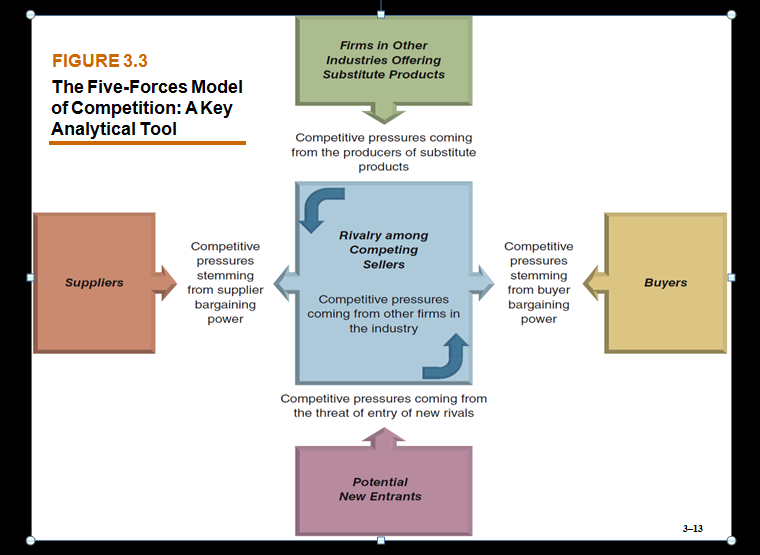
The Five Competitive Forces:
     Competition from rival sellers
     Competition from producers of substitute products
     Supplier bargaining power
     Customer bargaining power


let end here...to be continue...:)